
How to keep a blood pressure log for your doctor
Last updated
If your doctor has asked you to track your blood pressure at home, the log is what turns a handful of readings into something they can read at a glance. It does not need to be elaborate. It needs to be consistent, complete, and easy to hand over.
What a useful log contains
For each reading, write down:
- Date and time. Time of day matters as much as the date, because blood pressure follows a daily rhythm.
- Systolic, diastolic, and pulse. Systolic is the top number, diastolic the bottom. Most home monitors show pulse alongside them.
- Conditions. Anything about how the reading was taken that differed from your usual routine — which arm, whether you had time to sit quietly first. How to measure blood pressure at home covers the technique itself.
- Medications. What you take, the dose, and any change or missed dose during the period.
- Context. A short note when something stands out: a poor night’s sleep, a stressful day, caffeine, exercise, illness. A few words is enough.
The numbers are the core of the log. Context is what helps your doctor read them.
How often to measure
Your doctor’s instructions come first. If they asked for a particular schedule — certain times, a set number of days before a visit, readings before or after medication — follow that.
As a general reference, the American Heart Association’s home monitoring guidance says to measure at the same time each day, take two readings one minute apart each time, and record the results. Talk with your doctor about how often to measure; the right schedule depends on why they asked you to track.
Paper, spreadsheet, or app
All three work. The best one is the one you will keep up.
Paper. A notebook or printed chart next to the monitor is fast and needs no device. It is easy to bring to a visit. Averages and trends are left to you or your doctor to work out by hand, and a paper log can be lost or hard to read.
Spreadsheet. A spreadsheet can calculate averages and draw a chart, and it prints cleanly. It takes some setup, and typing into cells on a phone is fiddly enough that readings often get entered later.
App. An app keeps the log on the phone you already carry and can do the summarizing and formatting for you. Apps vary widely in what they cost, whether they require an account, and where your data goes, so it is worth checking before you commit months of readings to one.
attensio is one such app, for iPhone. Readings stay on your device, and in Apple Health if you grant permission; there is no account and no attensio server. It is one convenient way to keep a log, not the only way.
What to bring to your appointment
A summary on top and the full log behind it works well:
- The period covered and how many readings it includes.
- Averages for systolic, diastolic, and pulse over that period.
- Morning and evening, side by side, if you measured at both times. With any kind of log you can group readings by time of day and average each group yourself.
- Notable context. Days or readings where something was different, and any pattern you noticed, such as readings after poor sleep.
- Your medication list, with any changes during the period.
- The complete reading log, including readings that look unusual. Note what was different rather than leaving them out.
Then let your doctor interpret it. The log’s job is to show what happened, not to draw conclusions.
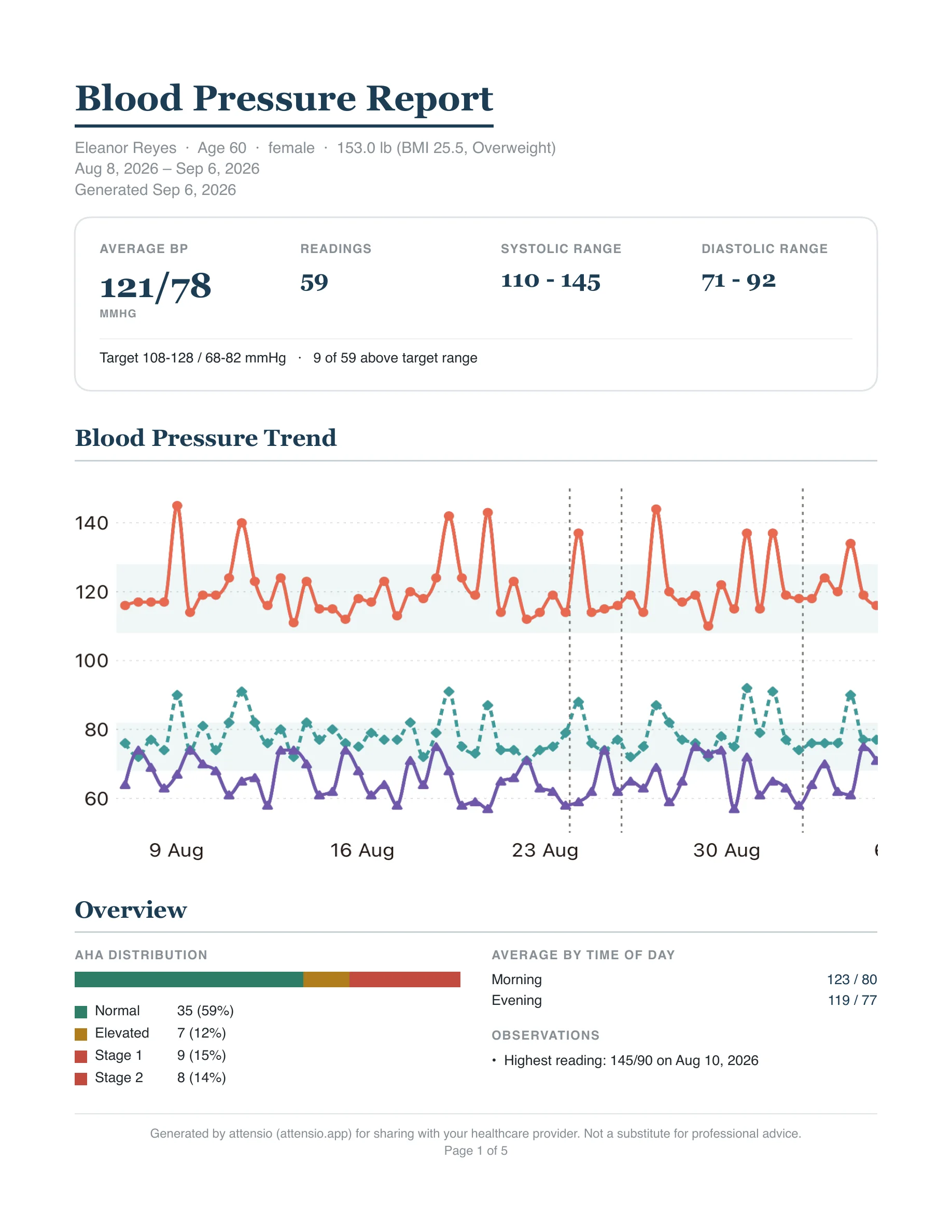
The image above is page one of attensio’s full report, a Pro feature, filled with fictional sample data. You can open the complete sample report (PDF) to see all five pages. Every attensio user, free or Pro, can create a clear 7- or 14-day report.
Common questions
Is a paper log good enough?
Yes. A legible paper log with dates, times, and all three numbers gives your doctor what they need. Other tools mainly save you the arithmetic and the formatting.
Should I include readings that seem off?
Yes. Record every reading and add a note about what was different. A complete log is more useful to your doctor than a tidy one.
How do I get the log to my doctor?
Ask the clinic how they prefer to receive it; many are happy with a printout at the visit. From attensio, you preview the PDF in the app and share it through the iOS share sheet — email, AirDrop, messaging, or Files. attensio does not send or host the report; it goes only where you send it.
What is the difference between attensio’s free report and the Pro report?
The free report covers the last 7 or 14 days: your context, a key-numbers summary, a tally against your personal target range, a trend chart, a medication summary, and the full reading log. The full Pro report adds analytic sections — an overview with an AM/PM split, factor correlations, and mood alongside blood pressure — plus a target-band overlay on the chart and a selectable date range of 7, 14, 30, or 90 days, or a custom range.
If you would like to use attensio
attensio is on the App Store for iPhone (iOS 18.6 or later). It is free to use, needs no account, and includes the 7- or 14-day doctor report. Pro is an optional one-time purchase, not a subscription.
attensio is a personal wellness journal, not a medical device, and nothing here is medical advice. Your doctor’s instructions always come first.
Sources
- American Heart Association: Monitoring Your Blood Pressure at Home
- American Heart Association: Understanding Blood Pressure Readings
Part of attensio's Learn reference. attensio is a personal wellness journal, not a medical device, and never offers medical advice.